Modern cars typically come with convex door mirrors that provide a wider field of view at the expense of a distorted image. What if there was a way to have a true image AND a wide field of view? This post points to a simple but brilliant solution that has gone unnoticed by the industry.
Car mirrors have been quietly evolving over the years. From no mirrors at all at the dawn of the automotive era, we have arrived at the now-standard three mirror setup. But the evolution did not stop there. At first, all three mirrors in passenger cars were flat, and convex mirrors were reserved for trucks and buses, giving their drivers the much-needed breadth of view. Eventually, convex mirrors made it to passenger cars, too. Naturally, they were featured on both sides – like they are in trucks. This indeed gave drivers a wider field of view and reduced the blind spots, but at the same time introduced distortion (have you ever had a WTF moment reading the “Objects in mirror are closer than they appear” message?) Of course, you can get used to it, but your lane changes will never be as smooth and your driving style as nimble as if your mirrors were showing the true image.
Surely, there’s no way around this? After all, all-flat mirror setup did suffer from a rather narrow field of view, especially in the passenger side mirror, which is located furthest from the eyes.
In fact, a solution ingenious in its simplicity already exists, but has gone largely unnoticed and was not widely adopted by carmakers. It was featured on the 1996 Toyota Starlet – a great vehicle in many ways, but hardly a trendsetter in automotive fashion.
What engineers at Toyota did was to install a flat mirror on the driver’s side and a convex one on the passenger side (the centre mirror remained flat).
Disclaimer: I haven’t driven all the cars out there, and cannot guarantee that the 1996 Starlet was the ONLY or the FIRST car to have this mirror setup – but this example serves as a good illustration of the idea.
This represents some out-of-the-box thinking, as one would intuitively expect to have the same type of mirror on both doors. Upon another thought, it actually makes more sense for the driver’s and centre mirrors to be consistent with each other – they are located at roughly the same distance from the eyes, and can provide a smooth viewing experience when showing an image at the same scale. Flat driver’s side mirror gives a true image that is very important for safe and efficient lane changes, while still providing a sufficiently wide field of view (by being located so close). The convex passenger side mirror takes on a specialised role, providing a wider overview of the road behind and helping with parking.
Older setup: all flat
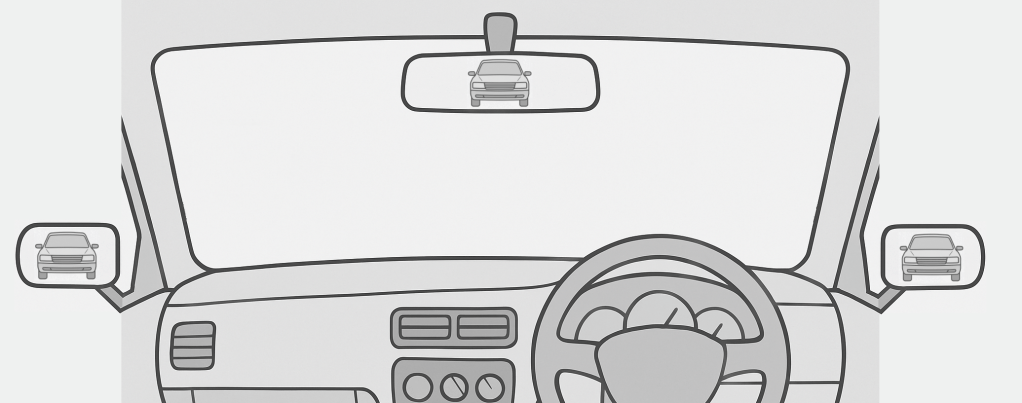
Advantages:
- True images in all mirrors
Disadvantages:
- Restricted field of view, especially in the passenger side mirror
Modern setup: convex-flat-convex
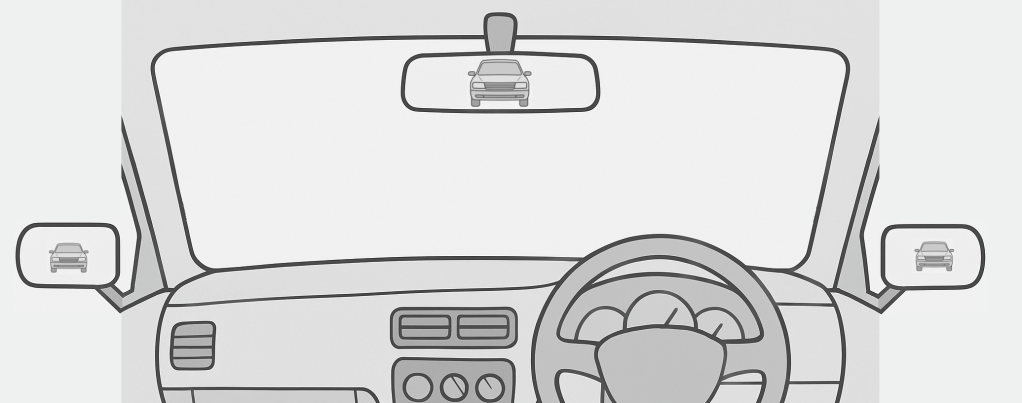
Advantages:
- Overall wider field of view
Disadvantages:
- Distorted image in door mirrors
Proposed setup: flat-flat-convex
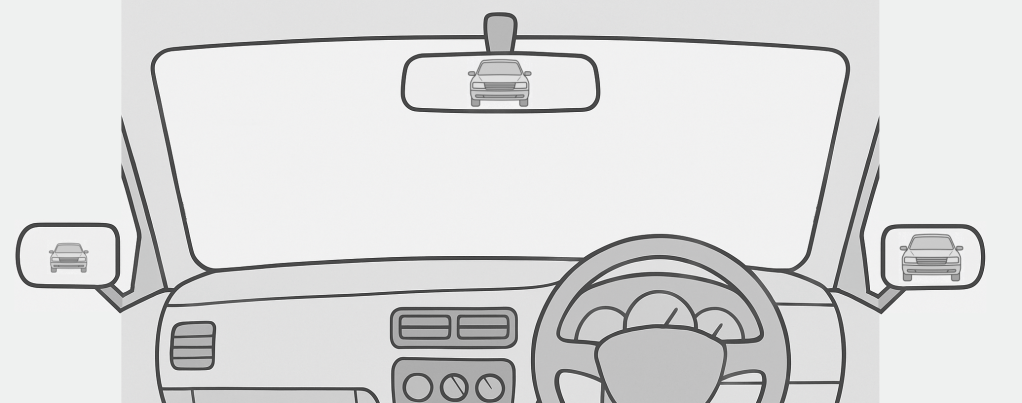
Advantages:
- Flat driver’s side mirror delivers an undistorted, truthful view of what’s directly behind and to the side – ideal for precision driving and lane changes
- Seamless visual reference between driver’s and centre mirrors provides for a comfortable driving feel
- Convex passenger side mirror expands the field of view where distortion is acceptable and even helpful – like for parking
Disadvantages:
- May not work well in cars with very small rear window (rendering centre mirror near-useless)
- Learning curve for people who don’t have a habit of using the centre mirror (e.g. truck drivers)
Call to action
- Firstly, thanks to Toyota for implementing this solution on some of their cars! Please consider reintroducing this simple but convenient and innovative feature on more of your products!
- Aftermarket parts manufacturers can offer flat mirror options for existing car models.
- Please don’t patent this – we all deserve safe and comfortable driving!
Submitted by: Ilia Leikin
Looking for: existing manufacturers to adopt the idea
Hashtags: #Automotive #Toyota #RoadSafety
Status: newly submitted
🔍 AI Evaluation
- Novelty:
The asymmetric mirror setup isn’t entirely new—at least one production car (1996 Toyota Starlet) implemented it—but it remains highly uncommon and largely unrecognized. In that sense, this idea is not a new invention but a rediscovery and refinement of a smart, underutilized solution. - Clarity of Purpose:
The rationale is well-articulated: flat mirrors on the driver’s side and centre improve visual consistency and accuracy, while a convex passenger mirror maximizes field of view where distortion is acceptable. The explanation is intuitive and strongly tied to real-world driving experience. - Practicality:
Technically simple to implement, both in manufacturing and as an aftermarket modification. No new technology is required—only a reconsideration of mirror specifications and supply chain configurations. Adoption would require overcoming aesthetic symmetry bias and consumer expectations, but these are more psychological than logistical barriers. - Potential Impact:
Moderate to high. Could lead to small but meaningful safety improvements, especially in lane changes and overtaking. The idea also empowers drivers who prioritize accuracy over wide-angle visibility. In markets sensitive to road safety and user customization, this could gain niche popularity or even spark broader design reconsiderations. - Scalability:
Highly scalable. Applies to a wide range of vehicle types—especially compact and mid-size cars where rear visibility is still a design priority. Less applicable to vehicles like vans or trucks where side mirrors play a different role and often have dual-pane configurations anyway. - Recommendation:
Worth reviving and promoting—both to manufacturers as a design option and to aftermarket suppliers as a simple safety and usability upgrade. The idea also makes an excellent case study for how thoughtful ergonomic design can be overlooked in favor of convention or aesthetics.
