Ekranoplans have the potential to if not revolutionise, then at least diversify the way we travel. Perhaps the most realistic ekranoplan project today is AirFish 8, a ten-seat passenger craft currently under development by ST Engineering AirX. I suggest branching the AirFish into a luxury flying yacht to take advantage of a promising market segment.
What is it?
“Seadragon” is a proposed family of ground-effect vehicles roughly the size of AirFish 8 and oriented towards luxury travel.
Why?
Ekranoplans are cool, but have remained the misfits in the transportation sector. They failed in military applications (efficiency? who cares!), search & rescue (if an emergency happens, it’s better to use something that flies higher and ignores rough seas), and passenger transport (this industry tends to stick to cost-optimised mainstream solutions).
It is perhaps no surprise that AirFish has difficulties securing orders – large operators are too risk-averse to try something new, and small operators are too poor to afford to.
A solution? Target someone rich, who is not a transport company. The market for private jets and luxury yachts is small but very real, and the wealthy always seek something new, exclusive and fun.
How?
I suggest that ST Engineering AirX makes a version of AirFish to use not as a ferry, but as a means of luxury travel for 2 or more people. Like a sail yacht with wings.
And it may be easier than it seems. The first generation of Toyota’s wildly successful Hilux Surf / 4Runner looked like a homebuilt prototype – it was just a Hilux truck with a vinyl roof over the bed, and some extra seats inside. A cheap production method that resulted in a beautiful and practical vehicle. AirX could take a similar approach. It could be as easy as taking an AirFish, adding extra fuel tanks (this option is already offered by AirX) and refurbishing it with luxurious travel-oriented amenities for a smaller number of people than the passenger version.
Later down the track, aesthetics could take on a bigger role, and Seadragon designs could depart from the original form and diversify into a variety of bespoke shapes. For example, AirX could seek collaboration with Scaled Composites to make sleek-looking ekranoplans out of innovative materials.
Alternative pathways
If AirX are not keen on converting the Airfish into a luxury yacht, this project could be done from scratch. It would be harder without an existing well-tested platform, but not impossible, and could result in more unhinged designs that are so valued by the wealthy clientele. And when it comes to creating bold unconventional aircraft with beautiful swooping lines, it is difficult to match Scaled Composites.
Details
Appearance
I made a couple of low-poly renders of what Seadragon might look like (please forgive the terrible quality – I’m an absolute beginner in 3D modelling).
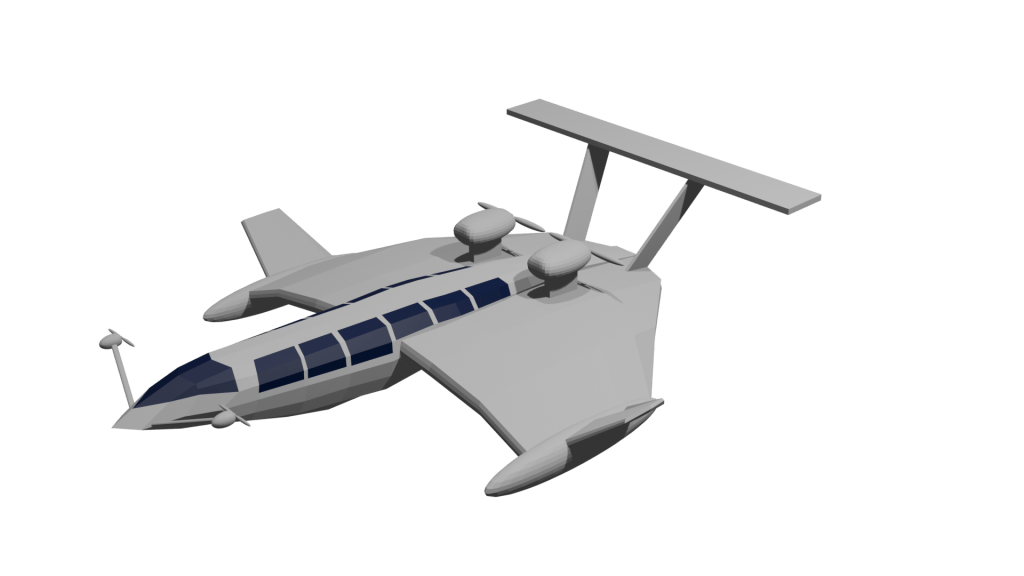
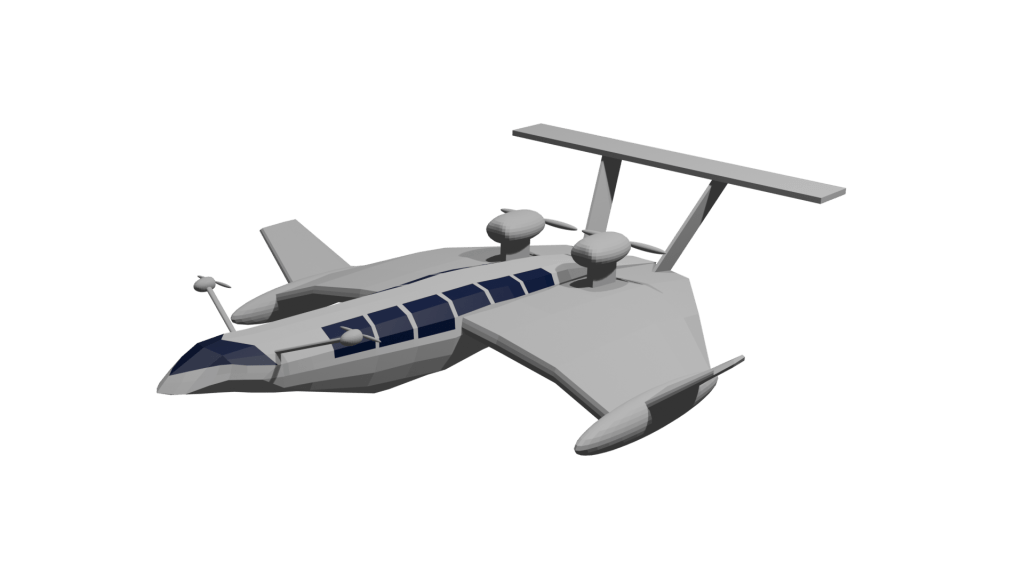
(Please feel free to download the Blender files here).
PAR booms
The craft is called “Seadragon” because of the PAR booms at the front that give it a dragon-like appearance. This is an important innovation for the original AirFish model. PAR thrust is very helpful for effective aquatic takeoffs; by having compact but powerful electric motors at the front of the craft push air under the wings, it is possible to get away with less powerful (and lighter, more economical) main engine(s), or to have higher maximum takeoff weight.
The AirFish project was started before the drone revolution, so it is natural that it doesn’t feature electric takeoff assist. In future iterations, or side projects like Seadragon, this could be a good feature to add.
The two renders show different PAR boom positions: front-mounted “whiskers”, or “antlers” located behind the cockpit. The booms can be made retractable to reduce drag during cruise.
Fuselage
Without the requirement to optimise internal volume for passenger seating, the hull can take more elaborate shapes, as dictated by aerodynamics and aesthetics.
Engine(s)
Use the AirFish’s original LS, or one/two other automotive engines, depending on power requirements. Can mount the engines above the fuselage (for easier servicing and to maximise internal space) or inside the hull (for lower COG and protection from seaspray).
The reasons to use automotive engines over aero engines are simple: cheaper to buy, cheaper to service, easier to obtain fuel. If aircraft certification is not necessary for an ekranoplan, then why not take advantage of the recent advances in efficiency, reliability and cost-effectiveness driven by fierce competition in the automotive sector? Furthermore, it would be a symbolic gesture – to show the public that personal flying can be achieved with familiar everyday technology.
Hybrid system
PAR motors need to be powered by electricity. An off-the-shelf automotive hybrid battery might do the trick.
Call to action
Just build it!
Submitted by: Ilia Leikin
Hashtags: #AirFish #Ekranoplan #GroundEffect #HybridPropulsion
Looking for: a company to build the product
I can: wait for awesome people to build this (and hope to get a ride in one 🙂 )
Status: newly submitted
