Smartlights provide endless opportunities for home automation, but their main appeal lies in their entertainment value. They’re just so much fun! Which means you’d probably wanna take it to a party, or bring it to the dinner table. Too bad the best ones out there are mains-powered. What if we could have a USB-powered version?
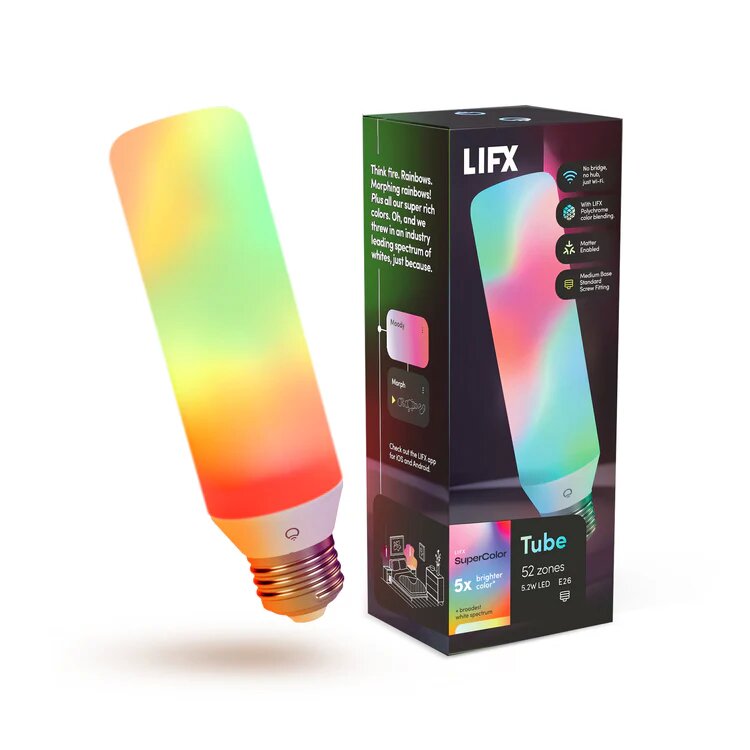
There’s a bunch of awesome smartlights out there that can be controlled wirelessly and change brightness or produce myriads of colours on demand.
But things are not so simple. Smartlights are an example of when innovation meets tradition: while being ultra-modern energy-efficient gadgets, they are normally made for old-fashioned mains-powered fittings, and are tricky to use with portable power sources.
This Reddit post describes the problem: the electronic components of the smartlight need low-voltage DC power, while the mains provide high-voltage AC. Conversion that happens inside the smartlight is not 100% efficient. And if we were to set up a portable power source, we’d need to convert from DC to AC, and then to DC again, so the losses would be even higher.
What if a smartlight could be powered by DC power in the first place?
Here are a few options for how this could be done (those of you with more electrical expertise, please feel free to weigh in on their feasibility and possible implementation):
Version A: USB-only
A smartlight powered exclusively via a standard USB-C cable. Comes with an integrated stand. Can be hooked up to a wall charger, car charger, or powerbank.
Pros: straightforward, simple
Cons: less flexibility in terms of positioning (hard to put it on the ceiling)
Version B: USB + mains
An Edison/bayonet smartlight with a USB-C socket. Comes with a removable stand.
Pros: extremely flexible deployment
Cons: more complex and expensive
Version C: universal smartlight
A smartlight with optional click-on adapters for USB-C, Edison and bayonet (of different sizes). Removable stand included, too.
Pros: truly universal
Cons: even more expensive to design (but unification of the main unit across different variants may offset these costs)
Feasibility
Typical smartlights consume under 10W of power, which is well within what modern USB chargers can provide.
Call to action
Smartlight manufacturers (LIFX, Philips Hue, etc.), please take note of this idea.
If your company makes mains-powered smartlights – with relatively low R&D investment, you could add a new much-anticipated product to your lineup, and stand out among the competition!
Submitted by: Ilia Leikin
Hashtags: #LED #RGB #Smartlight
Looking for: established company to create the product
I can: not much – I think I covered the idea well enough for someone to act on it
Status: newly submitted
