Particle Life is a fascinating computer simulation that uses a set of simple mathematical rules to create moving life-like patterns. The concept has been evolving over the years, with some of the major milestones being Jeffrey Ventrella’s “Clusters” (https://www.ventrella.com/Clusters/) and Sandbox Science’s “Particle Life” (https://sandbox-science.com/particle-life).
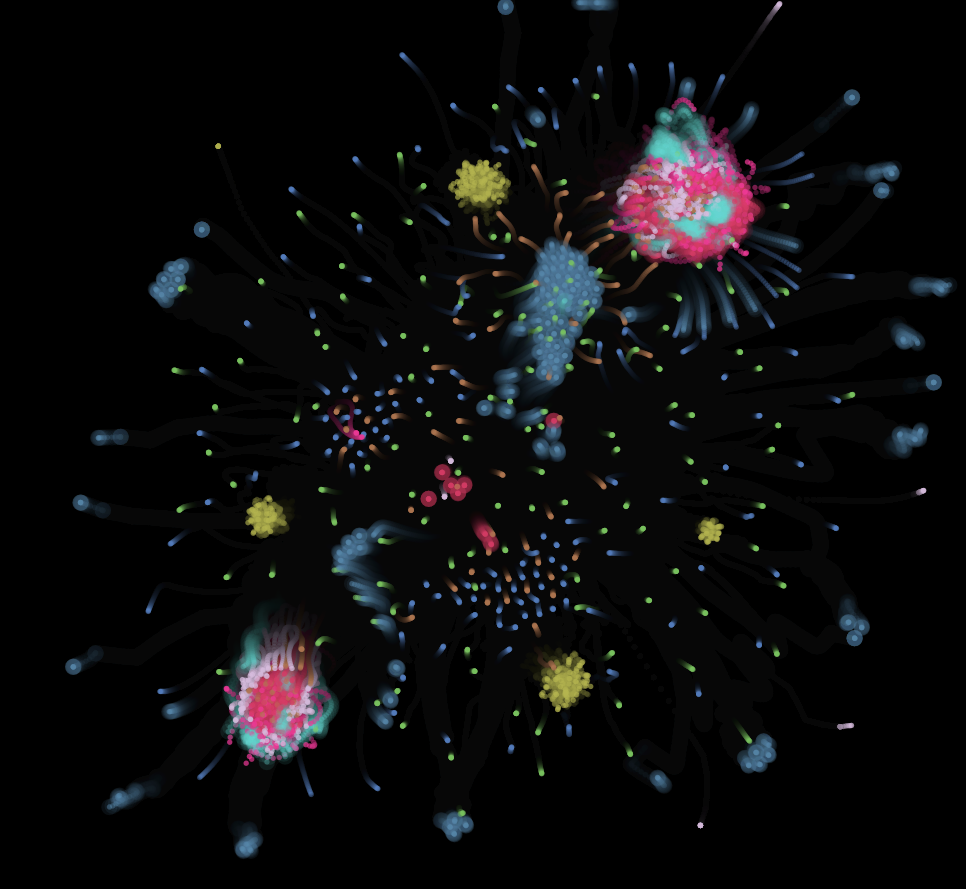
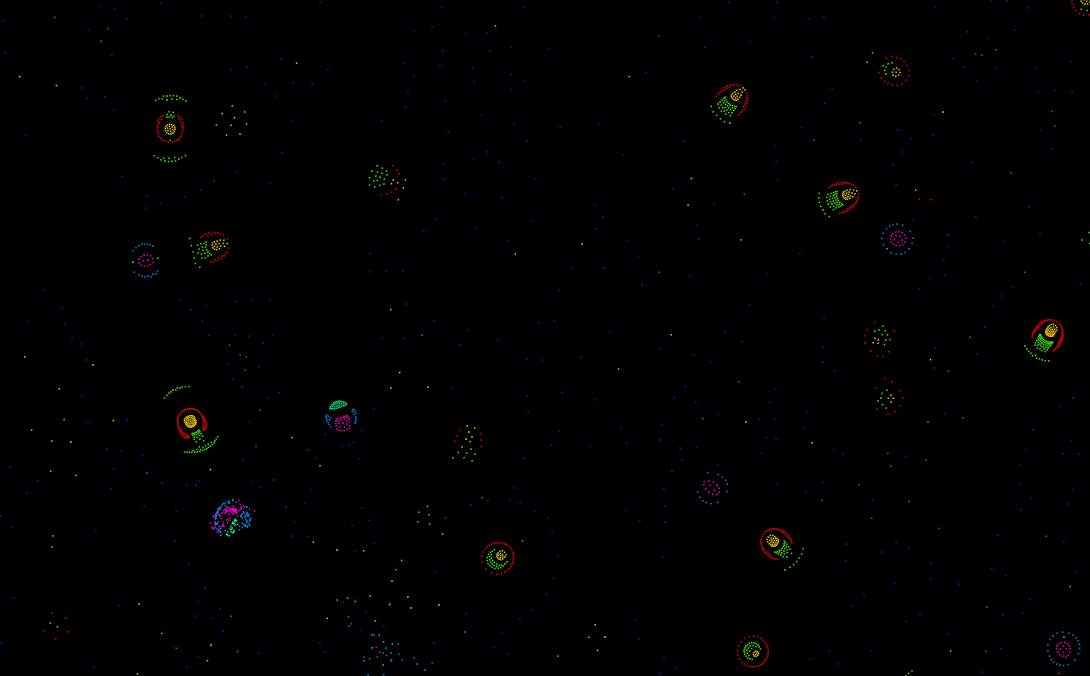
I propose making a computer game based on this concept.
Why make a game?
- Particle Life is a fascinating simulation in itself, but it is not a true video game because it provides little agency for the player (users can shift parameters to get different results, but nothing much beyond that). Gamifying the simulation could greatly increase its appeal.
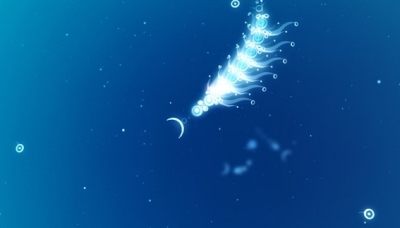
- Games with unusual ideas tend to gain popularity. For example, flOw (https://en.wikipedia.org/wiki/Flow_(video_game)) – a stylised simulation of planktonic life – was hugely successful.
How can we approach this?
There are lots of possible directions we can take this game, such as:
- A naturalist’s perspective: “hunting” rare and interesting artificial creatures. This can be implemented very easily by adding advanced screenshot and gallery functions to the simulation.
- A scientist’s perspective: “genetically engineering” digital creatures, watching them evolve, classifying them, etc. This is another relatively easy addition to the existing simulation.
- A “classic” video game: controlling an on-screen entity to hunt, fight or explore. We could use the diverse field of existing games to get inspiration for gameplay features.

Why this might work
- Game development doesn’t need to be extremely expensive and difficult. Indie games (including retro pixel art) are very trendy these days, so we don’t need to use the latest and greatest game tech. Instead, a fresh interesting idea is key.
- Modern tools, such as the Unity engine and AI assistants, make game development easier than it used to be. There are more indie games around than we probably realise.
- The mathematical/scientific aspect of the simulation can make it an attractive hobby project for students, academics and engineers.
- The Particle Life code is under GNU Affero General Public Licence – which means it can be freely built upon, including for-profit applications.
- Open-ended nature of the project is conducive to incremental development. It’s not “all or nothing” – even small additions can turn the simulation into a game, which can then be improved upon.
Possible challenges
- Like any project, it needs some commitment and hard work.
- Commercial rewards are unclear. We should enter the project not expecting to get rich&famous by completing it. Many indie game studios are “one hit wonders” – they create a game that really makes ripples in the industry, but do not proceed to become a large game studio regularly churning out masterpieces.
- The Particle Life code is under GNU Affero General Public Licence – which means it has to stay Open Source – this can make it harder to attract funding from investors.
Would you like to contribute?
Please feel free to leave constructive comments, or contact Inspiradrome if you’d like to join this project.
AI Evaluation
Novelty:
Highly original concept. Few games are directly based on emergent behavior simulations like Particle Life. The combination of digital naturalism and casual gaming could open a new subgenre, similar to the success seen by flOw and other experimental games.
Viability:
Moderate to High.
Developing a minimal viable product (MVP) would be feasible with a small indie team, especially leveraging open-source frameworks like Unity and Godot. A gradual development model (starting with simple interaction mechanics, then expanding) matches the incremental nature of the concept.
Commercial success is less predictable but not the primary aim here — audience engagement and community growth could be substantial.
Best Fit Audience:
- Digital artists and procedural generation enthusiasts
- Indie game developers looking for open-source collaboration projects
- Students or hobbyist programmers
- Game design classes (could even be used as a teaching project)
Hashtags: #IndieGames #MathematicalSimulations #EmergentBehavior #OpenSource #ProceduralGeneration #RetroGaming #GameDevelopment
Status: Early discussion


If you choose the “naturalist” scenario, I suggest adding the ability for the player to “capture” a lifeform not just as a screenshot, but including a bubble of physics (attraction-repulsion rules) and the states of all the particles that make up the creature (position, speed, direction). The player can then keep the creature archived (hello Pokemon!), and be able to release it into an “aquarium” to keep observing it.
Not sure how you’d implement an aquarium where creatures with different physics can coexist. For starters, perhaps need to enforce the rule where one aquarium has to hold creatures from the same “universe” (you can release any creatures in there, but they’ll probably disintegrate if the physics is too different).
LikeLike
If you have archived creatures, you can do experiments on them. Player can have an inventory of coloured particles, and feed them to the creature. Can tweak the physics, too – that will change the shape and behaviour of the creature.
LikeLike